
Here, Now, As You Are 🤍
We often speak about the evolution of a yoga practice, becoming physically stronger, more flexible in body and mind, more spacious in breath and awareness. Progress is easy to celebrate. It’s visible, measurable, reassuring.
But what happens when things regress?
When you arrive on the mat and realise that what once felt effortless now requires effort. When shapes that lived comfortably in your body feel distant. When your focus wavers more easily, when your patience thins, when the practice feels heavier rather than expansive.
This moment can be confronting. The mind quickly compares: I used to… I should be able to… Why can’t I now? Without noticing, we grasp at a previous version of ourselves, a past body, a past capacity, a past sense of ease.
Over the last year, I’ve found myself quietly mourning my own regress. Not in a dramatic way, but in the subtle ache of realising I’m not where I once was, in energy, in confidence, in ease. There’s grief in noticing the parts of me that felt expansive now feel tender, guarded, slower. And yet, within that mourning, I’m learning that regression isn’t failure, it’s information. A signal to soften, to listen, to rebuild with more truth than urgency. I’m meeting myself where I am, even when that place feels unfamiliar, and trusting that growth doesn’t always look like forward motion
This is where Asteya quietly enters the practice.
Asteya is often translated as “non-stealing,” but on a subtler level, it invites us not to take from the present moment by clinging to the past. When we hold tightly to what has been, we dilute our experience of what is. We steal from the richness of the here and now by measuring it against a memory.
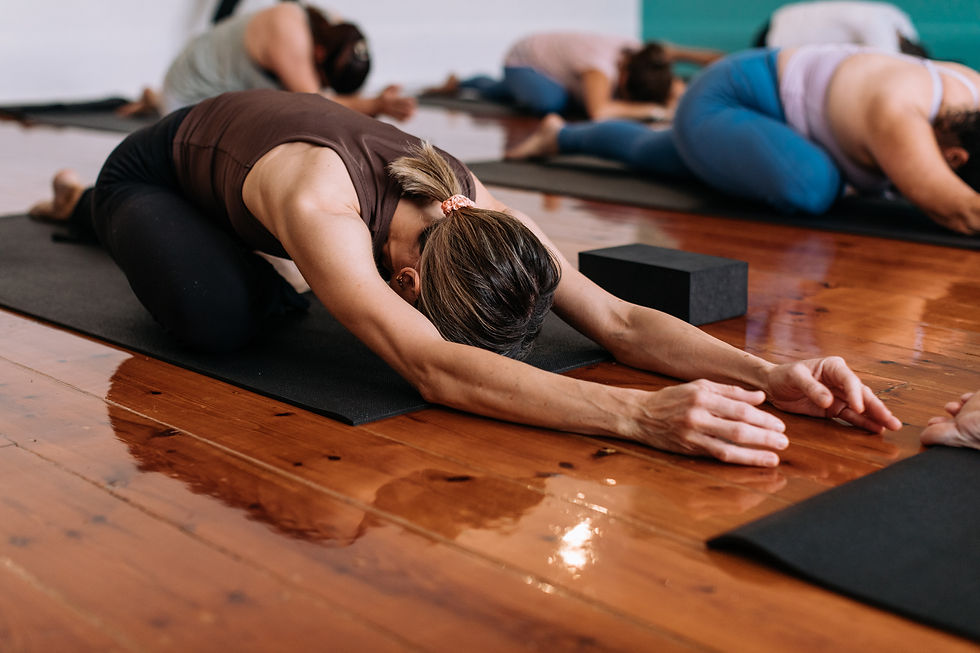
Regression in practice isn’t failure. It’s information. It reflects seasons of life, stress, rest, injury, growth, grief, joy, all the things that shape us beyond the mat. The body is not linear, and neither is awareness. A practice that once looked expansive may now ask for humility, curiosity, and deep listening.
Asteya reminds us to release the urge to grasp at former strength or flexibility and instead meet ourselves honestly, as we are today. Not with disappointment, but with presence. Not with judgment, but with compassion.
There is a different kind of strength found here, the strength to stay, to soften expectations, to let the practice evolve in ways that aren’t outwardly impressive but are deeply meaningful. When we stop trying to reclaim the past, we create space for something new to emerge.
The practice is not asking us to be who we were.
It’s asking us to be here.
And when we allow that, fully, nothing has been lost at all



thank you for sharing this 🤍
What you’ve described really is a shedding of identity letting go of who we once were in our bodies and making peace with who we are now. That can be confronting, but also deeply freeing.
I love that Yin has supported you in slowing down and softening into acceptance, rather than resistance. Movement doesn’t have to be fast or extreme to be meaningful, it just has to be continual, conscious, and kind. That’s where real vitality lives.
I’m so grateful the practice (and the space) has been part of that journey for you. Carpe Diem 🙏
Nice share Ness, this is something that I can definitely relate to, not just in yoga but other life activities as well.
For me it has become a challenge of accepting a body that is ageing, previous sports and physical activities that I participated in at a high level of energy and skill are now becoming slower and more difficult.
Practicing Yin Yoga (which mostly started at your studio) has actually helped me to slow down and most importantly accept that it's okay to move at a slower pace and take a step back from more extreme activities outside of my comfort zone.
Yoga has given me the opportunity to stop and look deeper inside to accept that where I…